News
A Visionary Who Helped Build a Movement: Remembering Iris Cantor
A Visionary Who Helped Build a Movement: Remembering Iris Cantor
The philanthropist, whose passing on February 22, 2026, at the age of 95 leaves a philanthropic legacy that will outlast generations, including a building at the heart of AWCIM's new campus
She started on Wall Street when almost no women did. She championed the health of other women when almost no one thought to. She kept Rodin alive in the consciousness of millions. And in 2019, she looked westward to the Sonoran Desert and made a bet on the future of medicine.
Iris Cantor, the nationally acclaimed philanthropist, women's healthcare advocate, and arts patron, passed away on February 22, 2026 in Palm Beach, Florida. She was 95. Her passing marks the end of a singular life devoted to building institutions that endure — and the University of Arizona Andrew Weil Center for Integrative Medicine (AWCIM) Iris Cantor Building is among them.
Cantor’s relationship with AWCIM began in 2017 with a leadership gift to establish the Iris Cantor Research and Innovation Fund — a commitment that reflected her long-held conviction that preventive care and whole-person medicine represent the future of health. “The UA Center for Integrative Medicine is making an indelible, positive impact on health around the world,” she said at the time. “It is the very reason I have offered my support for their mission to improve health and empower people in their own health care.”
That initial gift deepened into something more lasting. In 2019, Cantor and her foundation, The Iris & B. Gerald Cantor Foundation, both provided transformational funding that enabled construction of one of three structures in AWCIM's new campus complex. That building — the Iris Cantor Building — opened on April 24, 2024, its glass facade catching the Arizona light, its exterior panels designed to divert desert winds and reduce the need for air conditioning, its architecture as intentional as the medicine practiced within it. In a field defined by the belief that healing is inseparable from environment and purpose, the building itself embodies those principles.
“Iris Cantor’s kindness, sophistication, and generous vision shaped not just spaces but a movement of healing and hope. The Iris Cantor Building stands as a testament to her belief in integrative medicine’s power to transform health and well-being.”
— Dr. Stephen Dahmer, Andrew Weil Center for Integrative Medicine
For Dr. Stephen Dahmer, executive director of AWCIM, Cantor was more than a donor — she was a partner in a shared vision. "On behalf of all of us at the Andrew Weil Center for Integrative Medicine, I want to express our heartfelt condolences on the passing of Iris," Dr. Dahmer said. "She was an extraordinary leader and generous supporter whose vision and commitment have left an enduring mark on our Center. Her name will inspire future generations, especially through the Cantor Building, which stands as a testament to her dedication and belief in the power of integrative medicine to transform health and well-being."
Dr. Andrew Weil, the integrative medicine pioneer whose vision gave AWCIM its name and its purpose, reflected on what Cantor's support meant at the most essential level. "Iris has been a key supporter of my vision for integrative medicine since its earliest days," Dr. Weil said. "She actively collaborated with our Center and helped make possible our new building. Not only does she have my gratitude — she has a special place in my heart."
“Iris has been a key supporter of my vision for integrative medicine since its earliest days. Not only does she have my gratitude — she has a special place in my heart.”
— Dr. Andrew Weil, Founder, Andrew Weil Center for Integrative Medicine
Cantor's support of integrative medicine was not incidental — it was the natural extension of a life spent insisting that the world could be organized better, more humanely, and with greater attention to the whole person. Born and raised in Brooklyn, she entered Wall Street at a time when it was nearly all-male, and through her work there met her future husband, B. Gerald Cantor, founder of Cantor Fitzgerald and the world's foremost private collector of Rodin sculpture. Together they built one of the great philanthropic legacies of the 20th century, establishing the Iris & B. Gerald Cantor Foundation in 1978.
After Bernie Cantor's death in 1996, she continued without pause. Having lost her younger sister to breast cancer, she became a national advocate for mammography and early detection, founding the Iris Cantor Center for Breast Imaging at UCLA in 1986, followed by comprehensive women's health centers at UCLA and New York-Presbyterian/Weill Cornell. When data revealed that 40 percent of patients at the New York center were men, she opened the Iris Cantor Men's Health Center in 2012 — the first of its kind in the region. The Centers she built embody precisely the philosophy she shared with AWCIM: that human beings deserve care that treats them as whole people, not collections of symptoms.
The breadth of her honors reflected the breadth of her reach: the National Medal of Arts, presented by President Clinton in 1995; France's Legion of Honor, as both Chevalier and later Officier; honorary doctorates from multiple institutions; and the distinction of having the premier gallery of the Musée Rodin named in her and Bernie's honor — one of the rarest recognitions a French museum bestows.
What she gave to AWCIM was more than a building. It was affirmation — from a woman who had spent decades studying how institutions heal people — that integrative medicine belongs among them. The Iris Cantor Building will stand in Tucson long after the rest of us are gone, as she intended. In that sunlit glass and those desert-cooled rooms, her conviction quietly persists.
Please read her full obituary below, provided by the Iris & B. Gerald Cantor Foundation
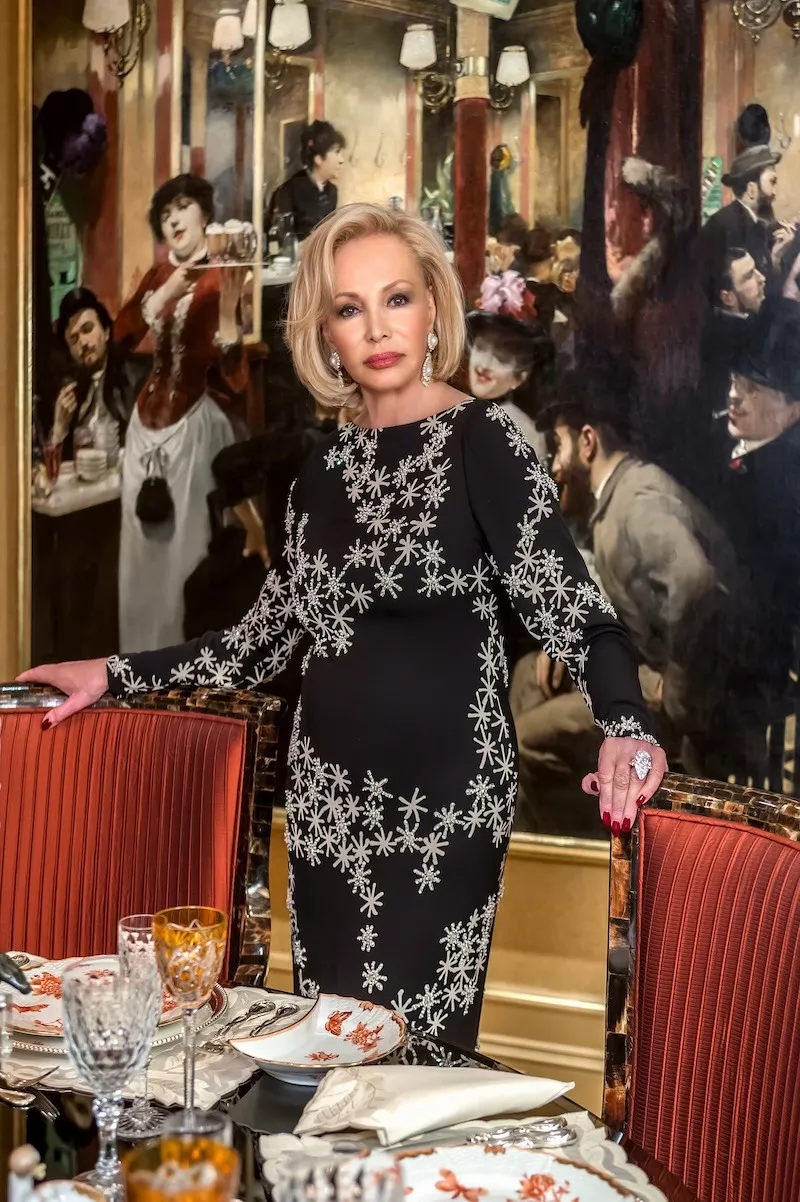
OBITUARY: ARTS AND HEALTHCARE CHAMPION IRIS CANTOR
Iris Cantor, nationally respected philanthropist, women’s healthcare advocate and champion of the arts, passed away on February 22, 2026 in Palm Beach, FL. She was 95.
As Chairman of the Iris & B. Gerald Cantor Foundation, Cantor nurtured the Cantor legacy in the visual arts, with a primary focus on the work of French sculptor Auguste Rodin (1840-1917) and his contemporaries. Equally passionate in support of women’s health, she also was instrumental in furthering gender-targeted healthcare and research at major medical and academic institutions on both coasts.
Born and raised in Brooklyn, NY, Cantor launched her career by joining a brokerage firm on Wall Street — then an avenue few women pursued. Through her professional activities she met her future husband, B. Gerald Cantor (1916-1996), founder of the securities brokerage Cantor Fitzgerald, Inc. A pacesetter in the financial arena, Bernie Cantor also was the world’s leading private collector of works by Rodin. The Cantors collaborated in organizing exhibitions, promoting scholarship on Rodin and donating artworks to museums and universities across the United States and around the world. They established the Iris & B. Gerald Cantor Foundation in 1978 to fund medical, educational and cultural institutions and programs in the United States and abroad.
In the ensuing years, the Foundation has sent traveling exhibitions of the Cantors’ beloved Rodin sculpture to cultural institutions throughout the country and beyond, reaching over 12 million people. In addition, their landmark gifts of sculpture have established or augmented Rodin collections at institutions including the Brooklyn Museum, College of the Holy Cross, the Los Angeles County Museum of Art, The Metropolitan Museum of Art, the North Carolina Museum of Art and Stanford University. Another significant beneficiary is the Musée Rodin in France, where Cantor was inspired to executive-produce the nationally acclaimed and award winning film documenting the first lost-wax casting of Rodin’s monumental work, The Gates of Hell.
“Her legacy is one of imagination, conviction, and unwavering belief in the essential role museums play—not only in what they show, but also in what they help us understand about ourselves and the world around us,” said Max Hollein, director and CEO of the Metropolitan Museum of Art.
After her husband’s death in 1996, Cantor continued to lead their foundation in supporting projects and programs consistent with their shared vision of furthering scholarship on Rodin and making the sculptor’s works accessible to the public. Other significant donations have expanded teaching and performance facilities at New York University’s Tisch School of the Arts, including a new film center and the university’s first professional proscenium theater. Cantor also was a philanthropic force on behalf of women’s health. Having lost her younger sister to breast cancer, she became a leading advocate for mammography as a tool for early cancer detection. She established the Iris Cantor Center for Breast Imaging at UCLA in 1986. She then expanded her interests to address women’s health comprehensively, founding a women’s health center at UCLA in 1995 and another at New York-Presbyterian Hospital/Weill Cornell Medical Center in 2002.
Within a decade, 40 percent of the patients at the New York women’s center were men. Responding to the clear need for a counterpart facility for men at New York-Presbyterian, Cantor established the Iris Cantor Men’s Health Center, the first of its kind in the New York region, in 2012.
The Iris Cantor Health Centers embody the perspective that Cantor was among the first, not merely to espouse, but to actively propel toward a new healthcare model: that men and women have different and unique medical needs and respond best to targeted care. In addition, all three facilities reflect Cantor’s belief in the value of treating the whole person and encouraging preventive measures and healthy lifestyles. Consistent with this perspective, her 2019 gift to the Andrew Weil Center for Integrative Medicine at the University of Arizona enabled construction of one of three structures comprising the new complex.
The Cantor legacy in healthcare is as comprehensive as that in the arts, and certain to be equally enduring. In a joint statement, the New York-Presbyterian Board of Trustees lauded Cantor, a Life Trustee, as “one of the earliest and most influential philanthropic voices calling for advancing medical research and improving care for all.”
Dr. Janet Pregler, director of the Iris Cantor-UCLA Women’s Health Center, noted that
“Iris Cantor’s vision for women’s health has been transformational. Her sustained advocacy has shaped comprehensive healthcare for tens of thousands of women.”
National Order of the Legion of Honor named her a Chevalier in 2000 for her work in promoting women’s healthcare as well as Rodin, and then elevated her to Officier in 2017.
In 2008 she received the Big Apple Award from the Tisch School of the Arts at NYU. New York-Presbyterian Hospital named her its Trustee of the Year in 2003 and honored her at its 2015 Annual Gala. Also in 2015, the premier gallery of the Musée Rodin was named "Hall Iris et B. Gerald Cantor," a distinction rarely accorded by a French museum. She received the New York Weill Cornell Council Leadership Award in 2018.
Cantor was active in the philanthropic and cultural life of her native New York as well as Los Angeles and Palm Beach, FL, serving on numerous leadership boards at universities, medical centers and arts institutions.
Iris Cantor was predeceased by her husband Bernie, her beautiful mother Faye, and her sisters Binnie and Enid. She is survived by her nieces Randi Aitken, Suzanne Fisher, Michele Geller, Monica Muhart, great-nephew Ryan Fisher, and many other loving nieces and nephews as well as family friend John Desiderio. Funeral services will be private. A celebration of life will be held in the spring.
Contact:
Ryan Fisher rfisher@ibgcf.org