Patient Education Library
Designed for both clinicians and the general public, these handouts provide practical, evidence-informed guidance that blends conventional medicine with complementary strategies. Within each handout you have the option to share or download a PDF.

Understanding Nutrition Labels
Nutrition food labels provide information regarding energy (calories), fat, protein, carbohydrate, and fiber content, type of fat, and vitamin and mineral content. Investigate the ingredients on the label to identify whether or not foods are highly processed (i.e., changed from its natural state by chemical or mechanical means).

HERE ARE SOME HELPFUL HINTS WHEN READING FOOD LABELS
- Be aware of labeled benefits, as these may be covering up for something else.
- If you can’t define it, neither can your body. If you struggle with defining label ingredients that seem like chemical names, that’s exactly what they are. These ingredients indicate that this is a processed food.
- Preservatives that make food last longer may have harmful effects on you body. Common food preservatives include compounds such as sodium benzoate, benzoic acid, nitrates, sulphur dioxide, sodium sorbate, potassium sorbate, and butylhydroxytoluene (BHT). These chemicals are linked with increased allergies, cancer risk, and may disrupt hormone signaling in our body including disrupting signals from our gut to our brain telling us we are full.
- Substitutes for sugar and fat are not necessarily healthier. Sugar substitutes are usually artificial or non-nutritive sweeteners which may be associated with allergies, digestive issues and may increase the risk of neurological problems. It is also especially important to avoid high fructose corn syrup which is linked to obesity and liver disease.
ADDITIONAL INFORMATION
The FDA has detailed instructions on how to read nutrition labels so you can make informed food decisions that will help you choose a healthy diet:
How to Understand and Use the Nutrition Facts Label
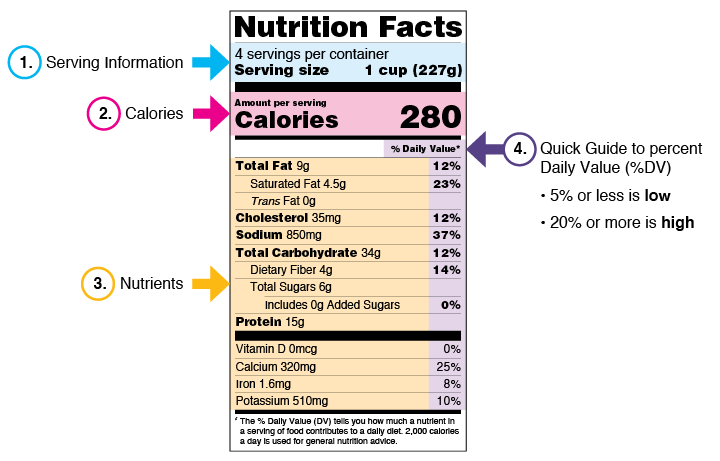
Image source: FDA
Disclaimer: Information provided is for general informational purposes only and is not a substitute for professional medical advice, nor does it establish a doctor-patient relationship. Always seek the advice of your qualified health provider. We assume no responsibility for errors or omissions in the content.
Find an Integrative Provider or Coach Near You
Search for integrative physicians and health experts. Partner with Andrew Weil Center-trained integrative providers who value your well-being, combine evidence-based methods to improve your health and merge conventional and natural approaches to address your mind, body, and spirit.
Visit the Tucson Clinic
Experience comprehensive care from Andrew Weil Center for Integrative Medicine clinic physicians, who offer expert consultations for various medical conditions while providing tailored recommendations for disease prevention.
Interested in becoming an integrative practitioner?
Ready to take the next step in your healing career? Discover how our educational offerings can help you blend science, compassion, and whole-person care. Enroll in our integrative health programs and gain the tools to combine modern medicine with holistic healing.
What is Integrative Medicine
Transform medicine and embrace whole person healthcare with an online course, in-person event, certificate program, or fellowship in integrative medicine.